Planting
Softscapes
Trees, shrubs and perennials chosen for a Kansas year, set into beds laid out around how water actually moves, with mulch and edging that hold their line.
Chapter 01
Plants that can take a Kansas year
The growing conditions here are not gentle. Hot dry stretches in July and August, wind that pulls moisture out of exposed sites, clay that holds water after a storm and then bakes hard, and a swing between those states inside a fortnight.
All of our plant material is sourced locally and is brought in on a weekly basis. That matters for a practical reason rather than a sentimental one. Stock grown in this region has already been through these conditions, so what goes in the ground is not spending its first season learning the climate.
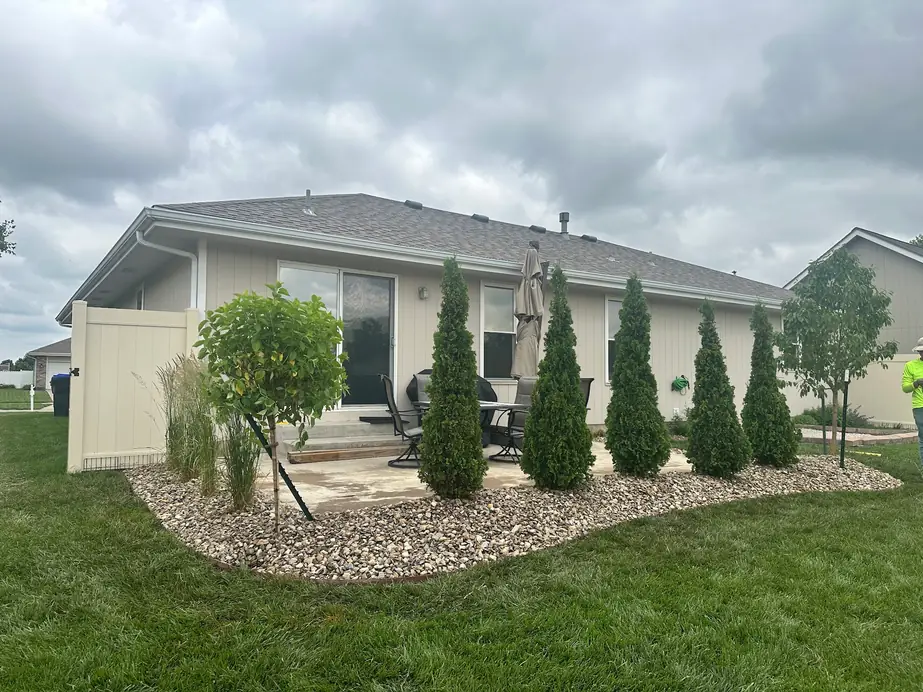
River rock foundation bed with a row of young arborvitae and ornamental grasses against maintained turf
Beds laid out around how water moves
Bed shape comes from the site evaluation. Where water leaves the roof, where it runs, where it sits. Planting the low point of a garden with something that wants sharp drainage is a slow and expensive way to find out where the water goes.
Plants get spaced at mature size, not at nursery size. A bed that looks correct on the day it is planted is usually a bed that will be crowded in three years. Edging holds the line between bed and turf so the shape survives the first mowing season.
Chapter 03
Soil before stock
The single biggest cause of a young shrub sulking for two years in this soil is a planting hole dug in heavy clay and backfilled with something much lighter. The hole behaves like a bucket. Water collects in it, roots circle inside it rather than pushing out into the surrounding ground, and the plant never establishes.
Amending across the bed rather than only in the hole, and setting plants at the right depth rather than deep, is what gets roots out into real soil.
The first two seasons
New planting needs deep and infrequent watering rather than a light daily sprinkle, which only ever wets the top of the root ball and trains roots to stay shallow. Mulch goes on at a depth that holds moisture without being piled against stems.
Some settling, some leaf drop and some sulking in the first summer is normal and not a sign the planting has failed. We will tell you which is which rather than leaving you to guess.
All plant material is sourced locally and brought in weekly. Landscape Industry Certified.
Planting
Planting plans come after the drainage is understood
Bed shapes, plant choices and spacing all follow from where water goes on your property. That is the first thing the site evaluation looks at.
Call the Auburn office on (785) 256-7300, or request a consultation and someone will come and walk the property with you.